
Landscape Showroom / RLC Selection Guide
Dwarf Walter’s Viburnum for Tampa Landscapes
Viburnum obovatum, dwarf cultivars
Also called: Dwarf Walter’s viburnum; compact Walter’s
Dwarf Walter’s viburnum offers small leaves and seasonal white flowers in a compact native-derived shrub. It is useful for a lower, quieter layer where sweet viburnum would eventually be much too large.
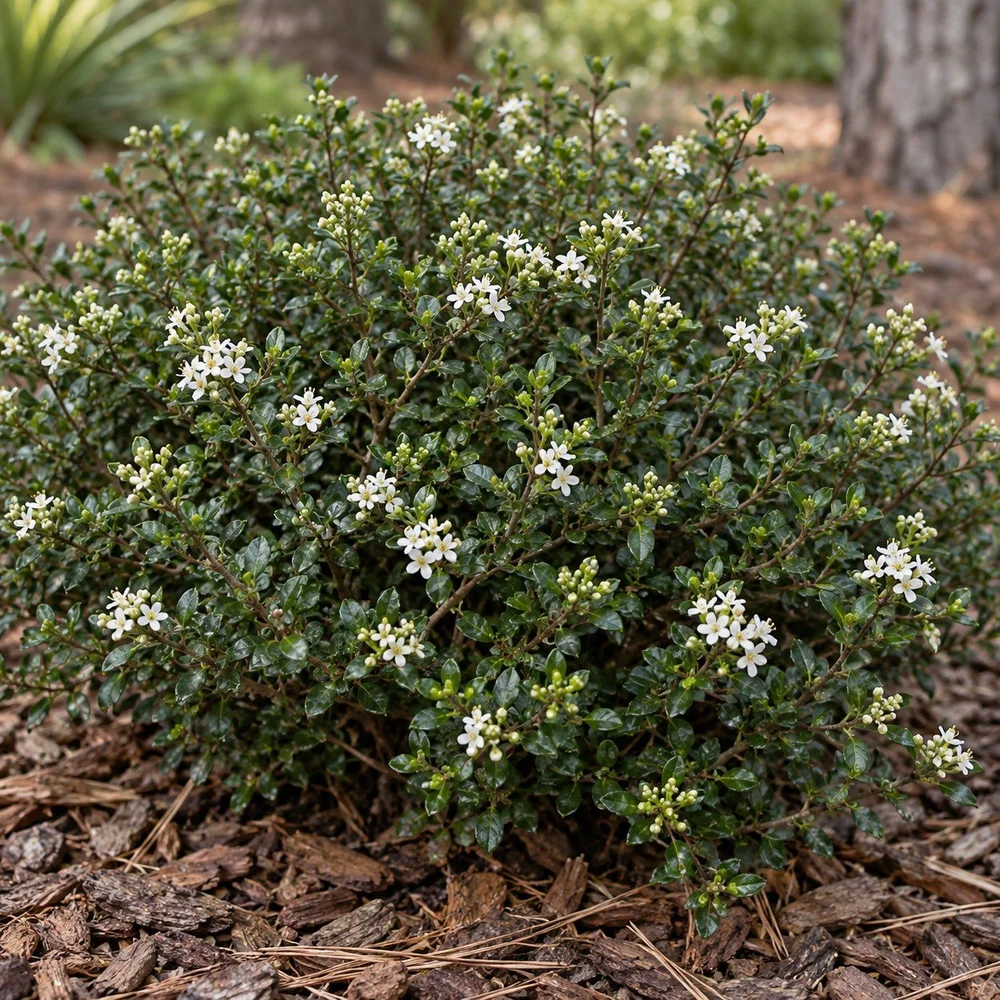
AI-generated illustration. Actual plants and materials vary; confirm the supplied selection with RLC.
At a glance
Climate & cold
Commonly Zones 8–10; selection of a Florida-native species
Mature scale
Cultivar dependent; compact forms differ substantially from the standard species
Sun & shade
Sun to partial shade
Water & drainage
Adapt to the site after establishment; check both root-ball moisture and drainage
Where it fits
Use near the front or middle of a foundation bed, with room for its natural branching. It can complement a native-oriented landscape or soften a formal planting. Give it enough space that the spring flowers do not have to be cut off for clearance.
Sizes and varieties
Densa, Mrs. Schiller’s Delight and other compact selections do not all finish at the same size. Standard Walter’s viburnum can become a large shrub or small tree. Sweet viburnum is another species entirely.
Care through the seasons
Prune with the desired flower display and natural outline in mind. Frequent shearing can remove developing blooms. Monitor young plants during dry periods and do not bury the base under repeated mulch applications.
Placement mistakes to avoid
Do not substitute an unnamed standard viburnum in a low foundation bed. A common name without cultivar information is not enough to predict the mature shape.
Buying size is not finished size
Commonly 3- and 7-gallon; name the cultivar in the quote. These are nursery formats to ask about, not a live stock list or a guaranteed height. Compare the actual canopy, root ball, cultivar and overall condition. Leave room for the mature plant, even when a new installation initially looks open.
Planning the installation
Measure the usable bed, including space around windows, paths, utilities and irrigation. Show RLC both a wide view and the details of the existing ground. Discuss removals, preparation, access and watering before choosing a quantity. A larger plant may give more presence on day one, but the right location and establishment care still determine the result.
What affects cost?
Relative starting plant tier: $$. A tier compares material categories; it is not an installed price. Nursery size, fullness, quantity, delivery access, removals and irrigation changes can alter the quote. Compare the whole scope, including the selected variety and size.
Common question
Is this a small version of Viburnum odoratissimum?
No. Walter’s viburnum is Viburnum obovatum. Dwarf cultivars of this species should be selected by name rather than treated as small sweet viburnum.
Bring the right details together
RLC Lawn & Landscape is based in Lutz and serves Tampa Bay. Share photos of your yard, approximate measurements and the options you like. We’ll discuss what fits the site and the work involved.
Reference: Plant or product information. Planning guidance reviewed September 2026. Availability and installed prices are confirmed by quote.