
RLC plant guide · Lutz & Tampa Bay
Petra croton
Codiaeum variegatum ‘Petra’
Bold leaf color for the middle layer of a tropical planting bed. Petra works best when its light, water and cold exposure are considered as carefully as its color.
$$ · Mid-range plant tier · Relative plant cost, not an installed price.
Save this in the showroom →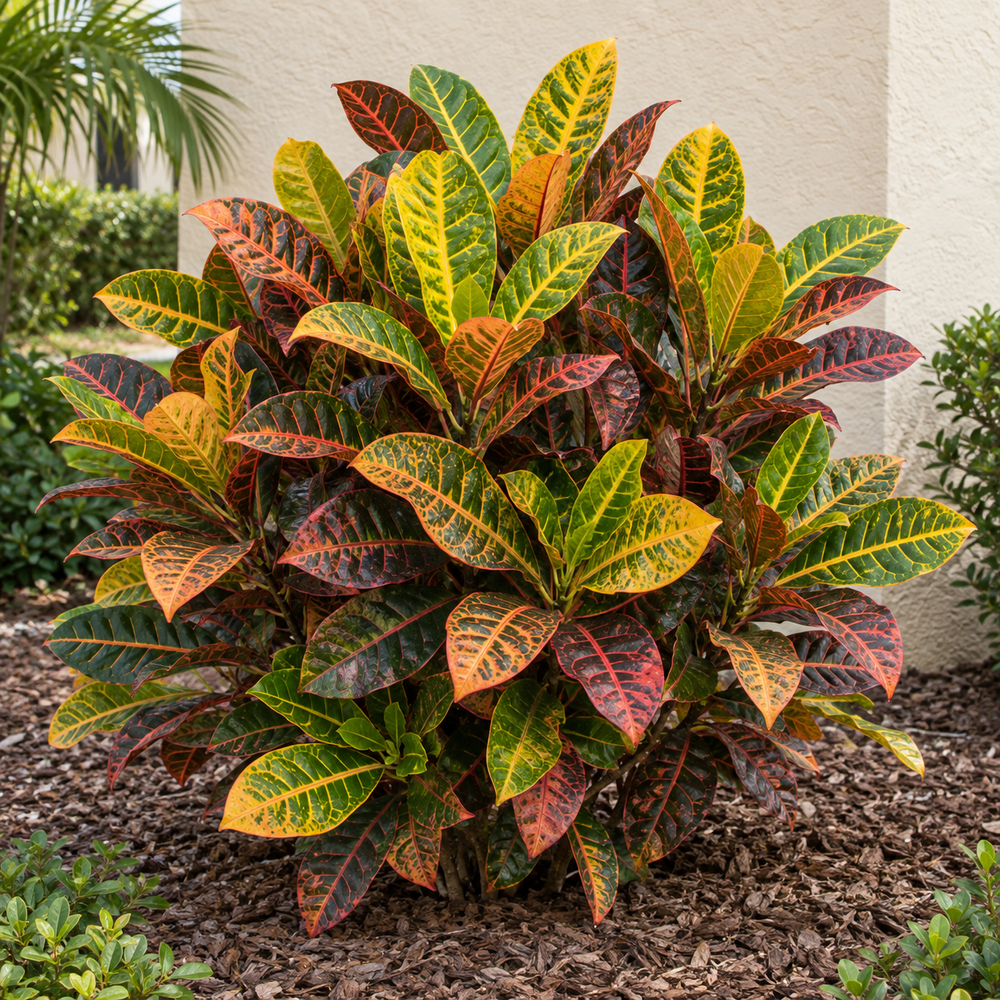
Know the plant
- Other names
- Petra; garden croton; variegated croton. “Croton” alone refers to many different cultivars.
- Plant family
- Euphorbiaceae.
- Plant type
- Tropical evergreen foliage shrub; not native to Florida.
- Climate guide
- Warm subtropical landscapes, often listed in the 9b–11 range. Protected Zone 9 sites remain vulnerable to frost and freezes; a zone label is not a survival guarantee.
- Foliage
- Broad oval to shield-shaped leaves with contrasting yellow, orange and red veins. New growth and light levels affect color.
- Size
- A medium-to-large shrub, not a permanent low border. Crotons can eventually reach substantial height; nursery pruning and cultivar affect form.
- Sun
- Bright light or shifting sun; acclimate plants to strong direct exposure. Deep shade can reduce color.
- Water & soil
- Moist but well-drained root zone. Avoid chronic sogginess and repeated severe drying.
Where it fits
Use Petra where leaf color can stand out against green shrubs, a light-colored wall or a palm planting. Repeating a few well-placed groups usually looks more intentional than scattering one of every color through a bed.
Leave space in front for lower edging plants and behind for access. Do not squeeze a growing croton against a walkway simply because it looks small in a nursery container.
In exposed inland Lutz yards, consider whether you are comfortable protecting or replacing cold-damaged tropical accents. A sheltered planting location can help, but does not make a croton freeze-proof.
What the nursery size means
Petra is sold in several container formats, including smaller retail pots and landscape shrub containers. Ask for a 3-gallon comparison first; larger 7-gallon material can be a sourcing request where available. Exact local stock must be confirmed.
Container size is only part of the comparison. Look at branching, leaf coverage, overall height and whether the plant was raised in shade or sun. An abrupt move from protected nursery conditions to harsh afternoon sun can affect appearance.
For an estimate, specify Petra by name rather than simply writing “crotons.” Include plant quantity and approximate installed dimensions so substitutes do not change the design.
Petra, Mammy and Gold Dust
Petra is recognized by broad leaves and strong contrasting veins. Mammy has a more curled, narrow-leaved look. Gold Dust has green leaves with yellow speckling.
These are different cultivars, not three guaranteed sizes of the same plant. Nursery labels such as “dwarf” should be tied to a named selection and its expected mature dimensions.
A mixed planting can use more than one croton, but each should have a clear role. Keep the surrounding palette simple enough that the leaf shapes and colors remain visible.
Care through a Tampa year
New plants need consistent moisture while roots move into the surrounding bed. Check the root zone rather than watering automatically because leaves look slightly different in midday heat. Keep irrigation from leaving the site waterlogged.
Allow time for plants to adjust after installation. Watch for prolonged wilting, leaf drop, mites or scale rather than treating every color change as a fertilizer problem. During hot dry spells, review root moisture and irrigation coverage.
Plan cold protection before a forecast freeze. Damaged foliage does not always mean the entire plant is dead, but recovery depends on severity and plant condition. Avoid promising unchanged winter color in an exposed yard.
Croton sap can irritate skin, and plant parts should not be eaten. Place it thoughtfully where pets or children may chew leaves, and use gloves when handling cut stems.
Questions homeowners ask
Does Petra need full sun?
It needs adequate light for strong color, but the best exposure depends on acclimation and site conditions. Bright shifting light can be useful; immediately moving shade-grown stock into intense sun can damage appearance.
Can I keep it small?
Pruning can manage the shape, but Petra is not a tiny groundcover. Choose a lower-growing plant when the bed has a strict low height limit.
Are the colors guaranteed to match this image?
No. The illustration shows the characteristic cultivar appearance. Individual plants, leaf age, season and light conditions change the balance of green, yellow, orange and red.
Choose it for the right place.
RLC Lawn & Landscape is based in Lutz. We can help coordinate your planting with privacy, mulch, edging, irrigation and the rest of your Tampa-area yard.
Plant references and nursery size examples: UF/IFAS croton care · Costa Farms Petra identification · Costa Farms cultivar comparison · Florida grower Petra profile. Nursery listings are examples of sale formats, not a promise of RLC inventory. Exact cultivar, size, availability and price are confirmed with your estimate.