
RLC interactive planning · Lutz & Tampa
Your yard.
A little more private.
Compare three hedge styles, planted nursery sizes and spacing. Remove the fence to see how the plants screen a cluttered yard, then bring your preferred layout to your estimate.
Loading your planted preview…
Fine-tune height & explore growth
A 3D planning illustration, not a photograph or a promise of growth. Ryan’s AI-generated scale figure shows his RLC work shirt and leather-style RLC hat patch at 5′11″ in work boots. The likeness is approximate and uses an image-based figure within the 3D scene. Fence and height references stay the same as the plants change. Use the view buttons or drag left/right to look around; scroll normally to move down the page.
Make this your starting point.
Save this view to share at your estimate. RLC can confirm plant size, fullness, spacing, irrigation and the right fit for your property.
How accurate are gallon sizes and planted heights?
Gallon size describes the nursery container, not a guaranteed height. RLC’s requested display examples are 1½ ft for 3 gallon, 2¾ ft for 7 gallon, about 4¾–5 ft for 15 gallon (shown at 4′11″), and 6¼ ft for 30 gallon. The 30-gallon example is also visibly wider. These comparison presets are used across the three hedge styles; actual heights, widths and available container sizes vary by species and grower. RLC will confirm current stock for your estimate. Adjust the installed-height slider to match your quoted plants. All sizes are shown planted in the ground.
Does the growth slider predict when I will have privacy?
No. The three rates are adjustable planning scenarios, not a forecast or a guaranteed range. The illustration allows a slower first year, then applies your selected annual rate until the desired hedge height is reached. Establishment, sunlight, water, drainage, pruning, cold events and plant health can change the outcome substantially. Height alone does not guarantee a dense screen; the illustrated spread and fullness are artistic estimates. A maintained hedge also needs room and regular care.
How do the hedge styles differ?
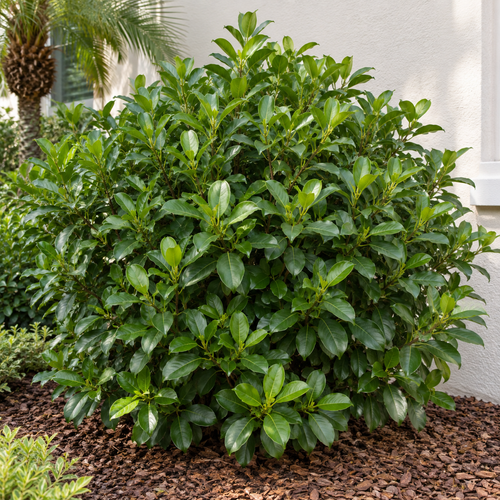
Sweet viburnum (Viburnum odoratissimum) has broad leaves and a rounded habit. Small-leaf clusia, commonly sold as Clusia guttifera, has thick, rounded foliage. Podocarpus (Podocarpus macrophyllus) has narrow foliage and a more upright habit. The preview changes leaf shape, color and canopy width to illustrate these differences. It does not confirm that every plant fits your site: sunlight, drainage, cold exposure, mature space and maintenance still matter.
What does the fence-free view show?
The shed, bins, tires and stacked materials are 3D objects behind the hedge. With the fence off, they can be seen through the gaps between plants. Changing gallon size, spacing and the growth slider changes the screening. Automatic fill keeps a 24-foot reference span between the outer planting centers; it adds plants as spacing decreases. Where spacing does not divide evenly, the row is centered within that span. Manual mode lets you choose 2–13 plants, with spacing adjusted when needed to stay within the span. Edge clearances and actual quantities require a site measurement. Objects, plant fullness and spread are illustrations, not a measured privacy percentage or a photograph of a neighboring property.
Where do the reference numbers come from?
Starting heights use RLC’s display specifications and must be confirmed against available nursery stock. Plant-form references: UF/IFAS living fences, UF/IFAS podocarpus, and UF/IFAS hedge options. Growth rates and canopy fullness are illustration assumptions, not species-specific forecasts. Fence heights are visual references, not statements about permitted fence heights.