Podocarpus vs. Viburnum vs. Clusia vs. Areca Palms: Choosing a Privacy Hedge
RLC planting guide · Privacy that fits your property
Choose the plant for the space, the winter exposure and the privacy you need on installation day. Podocarpus, sweet viburnum, small-leaf clusia and areca palms can all screen a yard, but they do not create the same kind of barrier or require the same care.
A gallon label tells you the nursery container category. It does not tell you how much of your fence, patio or neighbor’s window the plant will hide.
This comparison focuses on outdoor privacy planting in the Tampa Bay area. All four are long-lived perennial plants in suitable conditions, rather than seasonal flowers. Their useful lifespan depends on placement, weather and care; none comes with a guaranteed number of years.
Four plants, four different privacy strategies
Here, “viburnum” means sweet viburnum. Sandankwa and dwarf Walter’s are discussed below because substituting them can change the finished hedge substantially.
On a phone, swipe the table sideways. Each plant also has an expandable card below.
| Consideration | Podocarpus | Sweet viburnum | Small-leaf clusia | Areca palm |
|---|---|---|---|---|
| Privacy style | Fine-textured, formal hedge | Broadleaf green screen | Dense, thick-leaved screen | Feathery, informal clump |
| Cold suitability | Strongest cold-hardiness margin of these four | Good regional option; confirm the variety | Site-sensitive; avoid assuming freeze-proof foliage | Most cautious choice for a frost-prone yard |
| Growth expectation | Slow; slower in shade | Often vigorous in favorable hedge conditions | Slow to moderate in UF/IFAS guidance | Fast in suitable warm conditions; coverage stays feathery |
| Established water needs | Drought tolerant; well-drained soil | Dry-period tolerance; monitor stress | Drought tolerant once rooted in | Regular available moisture gives better performance |
| Main planning tradeoff | Allow time or purchase fuller starting stock | Allow width and recurring trimming | Match the site’s cold exposure and drainage | Allow frond reach; cannot be topped like a shrub |
This is a planning comparison, not a promise of performance. Source details and qualifications appear in the sections below.
Cold tolerance: survival is not the same as winter privacy
A plant can survive a cold event and still lose enough foliage to expose the view you planted it to hide. If year-round screening is essential, consider both survival and the risk of visible damage.
Compare the hardiness guidance
- Podocarpus: UF/IFAS lists zones 7b–11, giving standard P. macrophyllus the broadest cold-hardiness margin in this comparison.
- Sweet viburnum: UF/IFAS Gardening Solutions lists zones 8b–10a. That makes it a more conservative starting point than tropical palms for many colder properties, though tender growth can still be damaged.
- Small-leaf clusia: Extension observations report plantings into zone 9 and better cold performance than C. rosea. That is not a tested universal minimum temperature. Ask about the exact stock and the site’s history of frost before relying on it for uninterrupted privacy.
- Areca: UF/IFAS lists zones 10a–11. Treat exposed, frost-prone locations cautiously; a protected courtyard and an open inland boundary are different planting situations.
UF/IFAS: Podocarpus · UF/IFAS: Viburnum species · UF/IFAS: Small-leaf clusia identification · UF/IFAS: Areca palm growth and hardiness
What do the zone numbers mean?
USDA zones describe the average annual extreme minimum winter temperature. For orientation, zone 7b corresponds to 5–10°F, 8b to 15–20°F, 9a to 20–25°F, 9b to 25–30°F and 10a to 30–35°F.
These are climate bands, not temperatures at which these plants are guaranteed to remain undamaged. Freeze duration, wind, plant health, acclimation and the position in your yard also matter. Use the property’s exact location and observed cold pockets, rather than a citywide label alone.
Explore each privacy plant
Open the plant details for the buying and maintenance differences. Illustrations show general plant character, not a guaranteed nursery size.
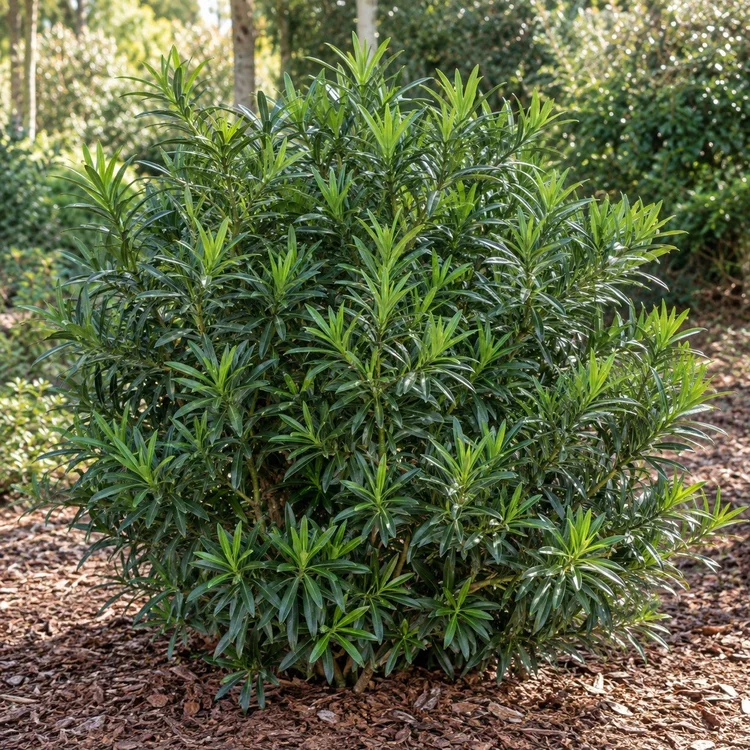
Fine foliage · Formal screen
Podocarpus
Podocarpus macrophyllus
A good starting point when cold resilience and a tidy, upright screen matter more than the fastest possible fill-in.
Details: Podocarpus
Standard podocarpus has narrow, dark leaves and takes well to hedge training. UF/IFAS rates its growth as slow; shade can make it slower and more open. Established plants tolerate drought, but the soil must drain.
Unpruned standard plants can become trees around 35–40 feet tall and 10–15 feet wide. A maintained hedge is a deliberate pruning commitment. Compact cultivars are a different purchase: confirm the exact selection before ordering a tall privacy row.
Nursery check: Look for branches near the base and usable foliage width, not just one tall shoot. Ask to see several plants from the actual batch.
Maintenance: Selective hand pruning gives a cleaner leaf finish than cutting through the foliage with shears.
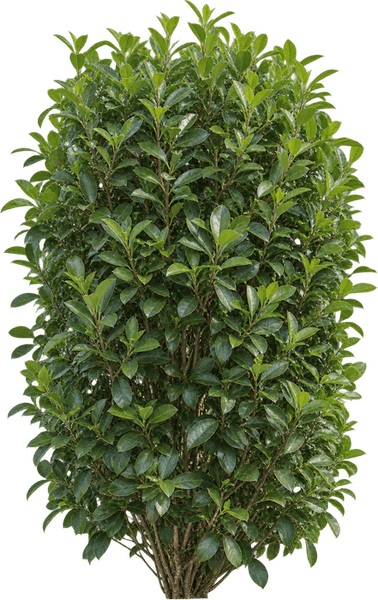
Broad foliage · Roomy boundaries
Sweet viburnum
Viburnum odoratissimum
Worth comparing when you want a substantial green screen and have room for its width and recurring pruning.
Details: Sweet viburnum
Sweet viburnum is a vigorous broadleaf shrub with fragrant spring flowers. In a favorable sunny site it can build a substantial hedge; shade can produce a thinner screen. It can reach roughly 25 feet tall and wide when allowed to develop freely.
The tradeoff: Fast growth continues after the hedge reaches your preferred height. Include trimming access on both sides in the plan.
Established plants can tolerate dry periods. New nursery plants still require establishment watering; drought tolerance does not mean a newly planted row can be left alone.
Nursery check: Compare branching and leaf coverage across the whole plant. A tall specimen trained as a small tree is not equivalent to a shrub branched from the ground.
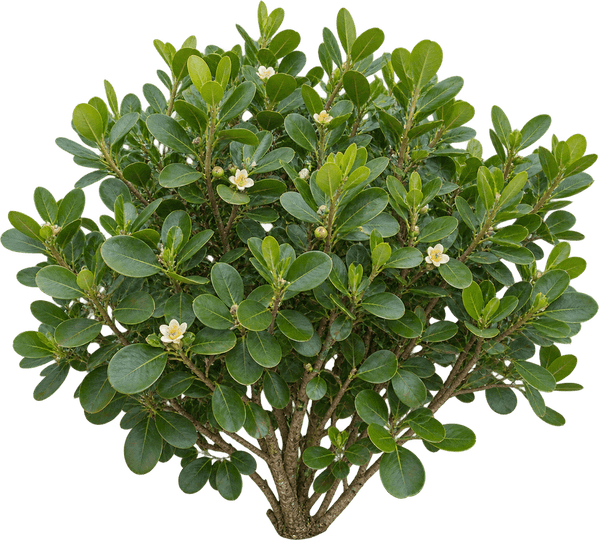
Thick leaves · Warm-site screen
Small-leaf clusia
Commonly sold as Clusia guttifera
A candidate for a dense, bold-textured hedge in a suitable warm location, with room to maintain its depth.
Details: Small-leaf clusia
Small-leaf clusia develops a dense barrier of leathery leaves. UF/IFAS describes slow-to-moderate growth, established drought and salt tolerance, and an unrestrained height around 20–25 feet. Do not assume every clusia will grow several feet each year.
Identification matters: The small-leaf hedge plant sold as Clusia guttifera is different from large-leaf Clusia rosea. UF/IFAS notes uncertainty around the trade plant’s botanical naming; request the small-leaf hedge form explicitly.
Nursery check: Look for side branches and foliage low on the plant. A few large leaves at the tips can make a sparse plant look fuller in a close-up photograph.
Maintenance: Inspect for scale insects and leave working space along the row. A dense screen still needs ongoing care.
UF/IFAS: Hedge selection and small-leaf clusia · UF/IFAS: Small-leaf clusia identification
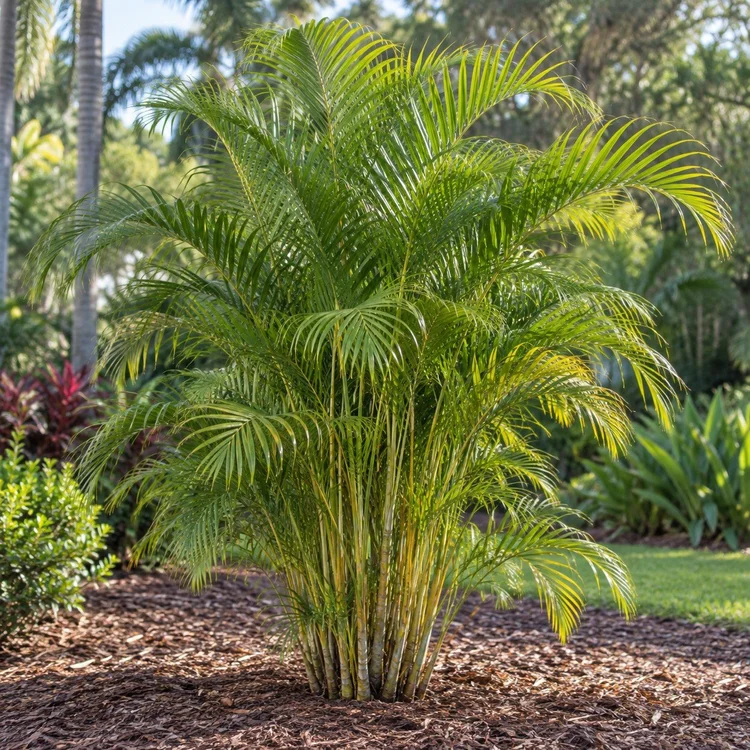
Feathery foliage · Tropical screen
Areca palms
Dypsis lutescens / Chrysalidocarpus lutescens
A softer, informal privacy option for a warm site with room for arching fronds and a spreading clump.
Details: Areca palms
Areca is a clumping palm, not a shrub that can be shaped into a flat-topped wall. UF/IFAS rates its growth as fast in suitable conditions. Published mature sizes vary, commonly around 20–35 feet tall with substantial crown spread.
Nursery check: Compare the number of canes, lower foliage and canopy spread. The highest frond tip can be much taller than the part that actually hides a neighbor’s window.
Maintenance: Keep healthy foliage needed for screening. Never top a cane to hold it at fence height: destroying its growing point kills that cane. Selective cane management changes the density of the whole clump.
Allow for palm nutrition and frond care. Areca has high nutrient requirements; yellowing should prompt an assessment rather than an automatic increase in watering.
UF/IFAS: Areca palm growth and hardiness · UF/IFAS: Areca palm form and moisture · UF/IFAS: Palm pruning · UF/IFAS: Ornamental palms for South Florida
AI-generated plant illustrations reused from the RLC showroom. Actual plants vary in shape, density and size; the images are not shown to a common scale.
Which viburnum: sweet, Sandankwa or dwarf Walter’s?
Sweet viburnum (V. odoratissimum) is the large screening shrub compared above. Sandankwa (V. suspensum) is a different species, often considered for a shorter, broader hedge. Walter’s (V. obovatum) is a Florida-native species; compact cultivars are not simply young sweet viburnums.
A proposal that only says “viburnum” leaves too much undecided. Confirm the species and cultivar, target height and bed width. The same gallon size cannot make these plants interchangeable.
Explore the Sandankwa guide and dwarf Walter’s guide.
Watering: a new hedge and an established hedge need different care
Every option needs a reliable establishment plan. Drought tolerance describes an established root system, not a plant just removed from its nursery pot.
During establishment: water the root ball, then check it
Direct water to the original root ball and check moisture there as well as in the surrounding soil. Rain or a lawn sprinkler may wet the bed while missing the roots. Avoid adding water to an already saturated root ball.
UF/IFAS describes shrub establishment as a process lasting months, with root redistribution potentially taking 6–12 months. A short handoff of “water for two weeks” is not a complete plan.
The schedule must reflect plant size, actual rainfall, drainage, sun and irrigation output. Research on small container shrubs should not be copied unchanged onto a large palm clump or a 30-gallon hedge.
Once established: how the four compare
Podocarpus and small-leaf clusia generally offer good drought tolerance in a suitable site. Sweet viburnum also tolerates dry periods once established. For all three, keeping a plant alive through drought and maintaining lush growth are different goals.
Areca palms perform best with available moisture and drainage. UF/IFAS describes moderate drought tolerance, but a dry, exposed site can be a poor match for the lush screen a homeowner expects.
Ask for a watering plan tied to the installed plants and irrigation equipment. “Ten minutes” means little without knowing the emitter output and whether each root ball receives it.
UF/IFAS: Podocarpus · UF/IFAS: Sweet viburnum · UF/IFAS: Hedge selection and small-leaf clusia · UF/IFAS: Areca palm growth and hardiness · UF/IFAS: Areca palm form and moisture
Wet soil, yellow leaves and irrigation mistakes
Yellowing or wilting is a reason to inspect the site, not proof that more water is needed. Check drainage, root-ball moisture and irrigation coverage first. Palms can also have nutritional problems that extra watering will not correct.
If water stays in the planting area, solve the site problem before choosing a hedge from this list. Keep the maintenance instructions with your project records and adjust watering to conditions and applicable local restrictions.
Growth rate: measure useful coverage, not just height
For practical planning, sweet viburnum and areca are the more vigorous options in favorable conditions; podocarpus and small-leaf clusia generally require more patience. That comparison does not mean an areca produces the same solid barrier as a broadleaf shrub.
Why we do not promise a fixed number of feet per year
Published growth labels differ, especially for viburnum. Nursery stock, cultivar, root establishment, pruning, light and weather can change the result. A newly planted row may spend its first growing season establishing roots rather than delivering the height gain expected from an established plant.
Evaluate three separate measurements: height to useful foliage, foliage width and density at the sightline you want to block. A long new shoot or an upright palm frond can raise the measured height without closing the gap.
Ask for a conservative expectation for the actual stock, plus photographs of its starting condition. A site-specific estimate is more useful than a universal promise of full privacy in six months.
UF/IFAS: Sweet viburnum · UF/IFAS: Podocarpus · UF/IFAS: Hedge selection and small-leaf clusia · UF/IFAS: Areca palm growth and hardiness
Need privacy immediately?
Choose and approve the starting coverage. Fuller plants, a different species or a changed layout may be needed. Simply purchasing a larger pot category does not guarantee a solid screen.
For a seating area, evaluate the view from the chair. For a neighboring window, consider the viewing angle and elevation. Fence height alone does not describe the privacy problem.
Use the Privacy Hedge Preview to explore the available plant options and spacing. Treat its future-growth views as illustrations, not a timetable or a nursery-stock guarantee.
Why the same gallon size looks different between plants
A 7-gallon podocarpus, 7-gallon viburnum, 7-gallon clusia and 7-gallon areca are not four equal-sized screens. Nursery gallon categories describe containers. Species, growing methods, pruning history and time in the pot determine what is above them.
Compare the screen you are buying: the exact plant, container category, height measured from soil level, foliage width, lower branching or cane density, root quality and quantity. Florida nursery grading considers form and quality in addition to container size.
What to check within the same container category
- Podocarpus: Is the plant a narrow, tall specimen or a well-branched hedge plant? Measure its leafy width.
- Sweet viburnum: Does foliage extend toward the ground, or is most of the bulk above bare stems?
- Clusia: Check the spaces between branches, not just the size of the leaves.
- Areca: Count the canes and inspect lower coverage. Overall height to the highest frond is not the same as a continuous privacy height.
These are inspection questions, not guaranteed differences in every nursery batch. Compare current photographs with a person or measuring stick for scale.
Comparing 3-, 7-, 15- and 30-gallon choices
3-gallon: Often considered where starting budget and willingness to wait are priorities. Check actual coverage rather than expecting an immediate fence-height screen.
7-gallon: Compare width and branching carefully; the label alone does not establish how much improvement it offers over the smaller stock.
15-gallon: Can provide a fuller start, but ask for the actual dimensions. Include handling, access and establishment in the estimate.
30-gallon and larger: Inspect the plant as closely as the smaller options. A large container is not a guarantee of good roots or uniform shape, and access can affect installation cost.
Availability varies by species and supplier. There is no reliable universal chart that converts these four plants’ gallon labels into identical heights. Confirm dimensions when the nursery batch is selected.
A simple example: height versus gap closure
Imagine two plants both measured at five feet tall. One has foliage two feet wide at your eye level; the other has foliage three feet wide. At four-foot center-to-center spacing, their initial geometric gaps would be roughly two feet and one foot respectively.
Those numbers are a hypothetical illustration, not a specification for any of these species. Real foliage is irregular and partly see-through, especially palm fronds. The example shows why height and pot size alone cannot predict privacy.
Spacing, mature width and the work you will live with
There is no one spacing suitable for all four plants. Decide the finished hedge depth, pruning access and sightline first, then choose stock and plant count. Review the hedge spacing and plant-count guide alongside this comparison.
Fences, narrow beds, pools and utilities
A hedge needs room beyond the nursery pot. Include foliage growth toward both the yard and the fence, access for pruning, gates, equipment clearances and drainage routes. Confirm property boundaries and applicable HOA or utility requirements before final placement.
In a narrow side yard, the first question is whether the mature planting can fit. Even a plant that tolerates pruning can become an ongoing struggle in a bed that is too small.
Near a pool, allow for frond reach, leaf or fruit cleanup and access to equipment. Areca’s arching form needs a different layout from a clipped shrub row.
Compare total ownership cost, not just the plant invoice
Request the same scope in each estimate: species and cultivar, size and dimensions, plant count, spacing, removal, preparation, irrigation, mulch, access and cleanup. Then discuss recurring trimming, palm care and potential replacement after weather damage.
A lower-priced plant may need more time to screen. A faster-growing hedge may need more trimming. A tropical appearance may involve a different cold-risk decision. The right choice is the one whose starting result and ongoing care suit your priorities.
Questions homeowners ask
Which is best for a colder inland property?
Start the comparison with podocarpus and an appropriate viburnum. Their published hardiness ranges provide a stronger cold margin than areca. Assess clusia individually rather than assuming the performance of a sheltered coastal planting will transfer to your yard.
Can areca palms be kept as a six-foot box hedge?
They are a poor match for that expectation. Palms grow from cane tips and cannot be repeatedly topped like branching shrubs. Choose a shrub when a controlled, flat-topped screen is the goal.
Will these plants stay green all year?
They are evergreen choices in suitable conditions, but evergreen does not mean damage-proof or leaf-drop-free. Cold, water stress, pests and pruning can change density. Plan for the possibility of temporary gaps where continuous privacy is essential.
Can I mix the plants?
Yes, if the layout accommodates their different sizes and care. Grouping compatible plants in sections or layers can be easier to manage than alternating a palm and a clipped shrub in a tight row. Keep one coherent plan for spacing, access and irrigation.
Which plant is cheapest installed?
There is no fixed winner across every size and project. Compare quotations for equivalent starting coverage and complete installation scope. A plant-price comparison without width, fullness and quantities can be misleading.
Let’s choose the right screen for your yard.
Tell RLC your approximate hedge length, desired privacy height, available bed width and property location. Photos of the area and the view you want to block help us compare suitable plants and starting sizes.
Request a privacy hedge estimateCall (813) 767-4022Plant references and how to use this guide
Research checked October 6, 2026. The comparisons combine the horticultural references below with practical questions to ask when planning an installation. Nursery availability, actual dimensions and site suitability must be confirmed for the project. Hardiness zones and growth categories are guides, not warranties.
- UF/IFAS: Podocarpus
- UF/IFAS: Sweet viburnum
- UF/IFAS: Viburnum species
- UF/IFAS: Small-leaf clusia identification
- UF/IFAS: Hedge selection and small-leaf clusia
- UF/IFAS: Areca palm growth and hardiness
- UF/IFAS: Areca palm form and moisture
- UF/IFAS: Establishing shrubs
- UF/IFAS: Palm pruning
- UF/IFAS: Ornamental palms for South Florida
- Florida Grades and Standards for Nursery Plants
- USDA: Plant Hardiness Zone Map